
CozyWorld game guide · By CozyWorld
This guide covers our own game, written from the current game rules and browser checks.
Lily Leap: Aim Where the Lily Pad Is Going
Your frog lands where you tap, but the lily pad keeps moving. Lead each pad, keep hopping before it sinks, and see how far three frogs can cross.
Lily Leap is our endless frog jumping game. A little frog starts on the grassy shore of a pond that goes on and on, and every row of lily pads you reach is one more meter. You choose each landing spot with a tap, but the pads keep moving while the frog is in the air, so the whole game is about aiming where a pad is going to be. Three frogs decide how far you get; a first crossing often ends somewhere past Reed Bend, and careful players reach Lily Meadow and Turtle Cove.
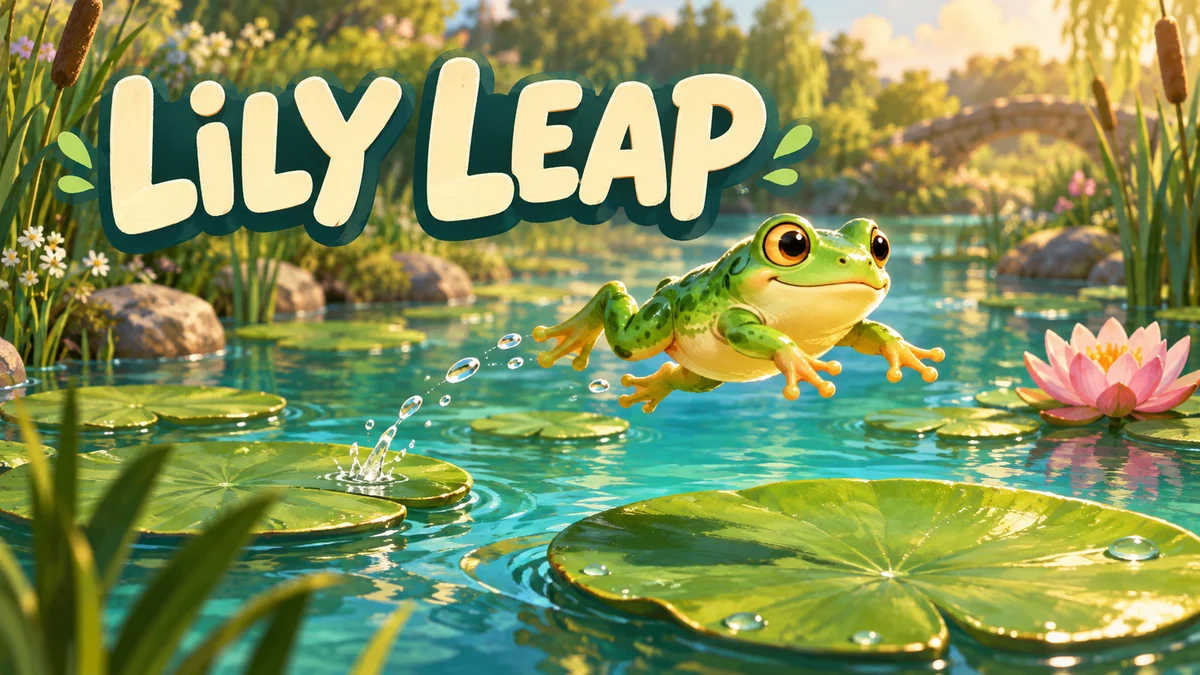
One tap chooses the whole hop
Press Play. On a phone or tablet, tap a spot on the pond and the frog hops there. On a computer, a white landing ring follows your mouse over the pond without any button held, and a click sends the frog to it. With a keyboard, the arrow keys or W, A, S and D move the ring and Space or Enter hops. A dotted circle around the frog shows how far it can reach, which is a little more than one row.
Every hop takes 0.6 seconds, and the landing spot is fixed the moment the frog jumps. The pads do not wait. A pad gliding to the right will be a little farther right when you arrive, so tap a little ahead of it. The first rows teach this: the opening three rows hold still pads, then the moving pads on the first ten rows show a dotted outline of exactly where they will be when a hop lands. After Reed Bend, at 10 meters, you judge it yourself.
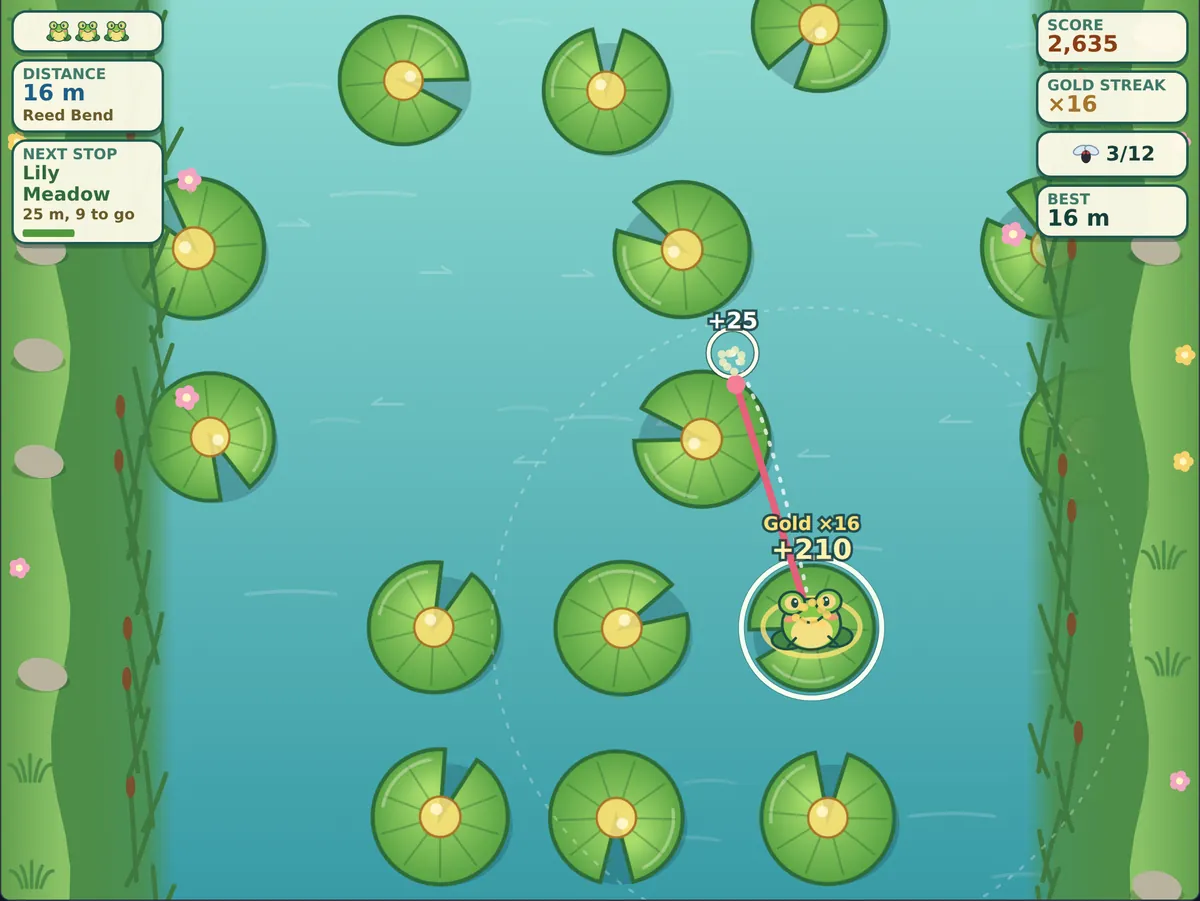
Lead the pad, then keep moving
Pads move in different ways, and each kind gets a short banner the first time it appears. Swaying rows slide side to side together and slow down at each turn. Bobbing pads drift toward you and away, so time the hop for when they come close. Drifting pads and logs glide steadily across the pond, the rows taking turns in opposite directions. From 46 meters, pairs of pads swirl in loops; lead them along the curve.
You cannot wait forever. Every lily pad sinks under a frog that sits too long, and a ring around your pad drains to show the time left: about six seconds on the first rows and less the farther you go. Yellow pads with holes, from 32 meters, sink in about a second and a half. If nothing ahead lines up in time, hop sideways to another pad on the same row; it costs nothing.
Watch the other platforms too. Logs never sink, but they and drifting pads carry you sideways, and red arrows flash when the reeds at the pond's edge are close. Lily flowers, from 26 meters, bloom and close; landing on an open one is worth a bonus, but a flower shakes before it closes and drops a frog still standing on it, and a closed bud cannot be landed on. Turtles, from 41 meters, are safe to ride until their shell flashes, and then they dive.
Points, gold streaks and bugs
Each new row is one meter and 10 points. Sideways and backward hops score nothing, so the points always come from moving forward. Every platform has a golden center: the gold spot on a pad or stone, the middle of an open flower, the center of a turtle's shell, or the golden knot halfway along a log. Landing on it on a new row adds 20 points times your gold streak, so the first gold landing adds 20, the second in a row 40, and so on up to 200 for ten or more. A plain landing or a splash starts the streak again. An open lily flower adds 40 more, and each named place adds 100.
Flies and dragonflies buzz over the pond. When one is within reach of the tongue, a dotted ring appears around it; tap or click it to snap it for 25 points, or 75 for a dragonfly. You can snap from a pad or in the middle of a hop, and the tongue does not slow you down. With a keyboard, F or X snaps the nearest bug. Every 12 bugs win back a lost frog, or pay 250 points if you still have all three.
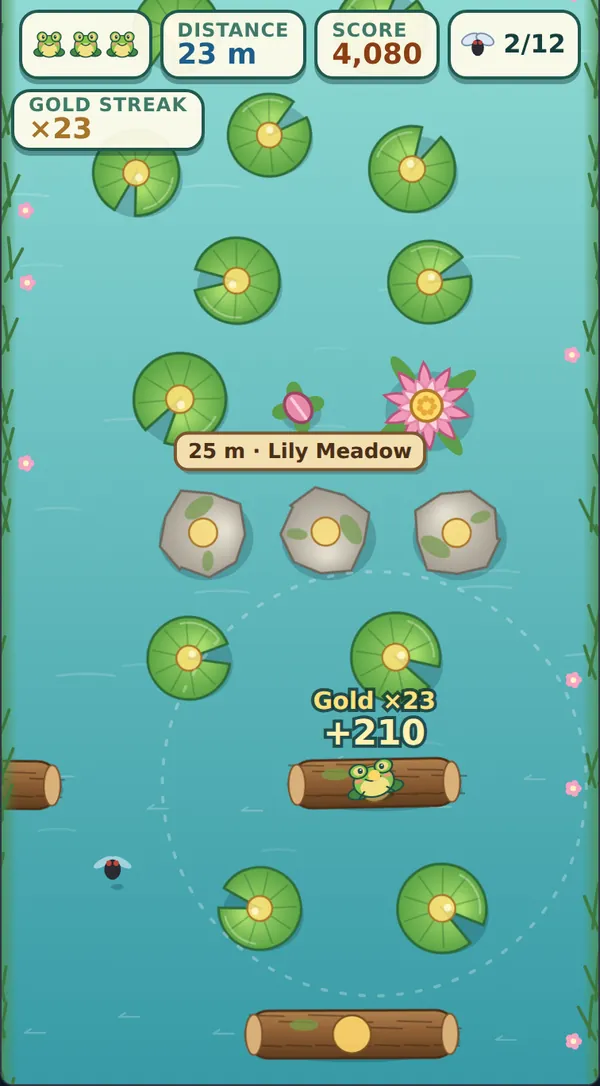
Splashes, milestones and the rising pace
A frog splashes when it lands in the water, rides a sinking pad down, stays on a closing flower or a diving turtle, or drifts into the reeds. After a splash it climbs back onto the shore, or onto a fresh lily pad on the row it last stood on, with a few seconds to plan the next hop. When all three frogs have splashed, the crossing is over.
Named places mark the way: Reed Bend at 10 meters, Lily Meadow at 25, Turtle Cove at 40, Willow Shade at 60, Dragonfly Hollow at 80 and Lotus Lagoon at 100, then Mossy Narrows, Sunset Shallows, Moonlit Reach, Firefly Isles and the Far Shore at 300, with open water every 50 meters after that. Each one is a row of three mossy stones that never sink, so it is a good place to breathe. The pond turns from morning to sunset to moonlight as you go, and the pads get faster, smaller and quicker to sink until about 316 meters.
Small screens, breaks and saved records
On a phone held upright the pond fills the screen, with the frogs, distance, score and bugs along the top. On a computer or a phone turned sideways, the grassy banks on both sides hold the score panels and the pond stays clear. Tapping the pond never scrolls the page. Pause freezes everything, including a hop in the air, and opening help while paused keeps the crossing paused. Phone and landscape layouts were checked with browser touch emulation, not physical devices.
When the crossing ends, the results show how far you got and the place you reached, your score, gold landings, best gold streak, bugs snapped, the time, and how far the next place is. Only the Play again and Title buttons continue, so a stray tap cannot start a new crossing by accident. Your best distance, top score, best gold streak and most bugs are saved in this browser; a crossing in progress is not. If you played the first eight-hop version, its best score is kept on the title screen as your classic best.
Another crossing, or a different kind of aim?
Every crossing is a new pond, so a longer one comes from reading the motion sooner, not from memorizing a route. If you would rather steer something continuously, try Duckling River Rescue. For a slower kind of aim, Garden Putt lets you line up every shot before you take it.
- Duckling River Rescue: steer Mama Duck down a river and gather ducklings
- Garden Putt: aim a ball around garden obstacles
- Orchard Catch guide: steer a basket beneath falling fruit
More guides and roundups
Want a bright runner with readable obstacles and tablet-friendly movement? Start with Bunny Garden Run, Firefly Hollow or Duckling River Rescue, then try these cozy flow games.
Best Cozy Mini Golf Games to Play in 2026Want tiny trick shots, gentle physics, and one more angle to try? Start with Garden Putt, then try these cozy mini golf and putting games.
Mossy Stack Guide: Perfect Drops and StreaksEvery drop leaves a little more, or a little less, room for the next one. The useful skill is anticipating the swing so Perfect streaks keep your tower wide as it speeds up.
Carrot Pop: Pick the Carrots, Let the Moles PeekOrange roots and green leaves mean tap. Purple ears and paws mean wait. Gather 20 carrots, then start a fresh garden inside the board.