
CozyWorld game guide · By CozyWorld
This guide covers our own game, written from the current game rules and browser checks.
It Takes a Village Guide: Villagers and Builds
Children love a big gang, grannies bake pies and cats simply cheer everyone up. Here is how villagers, moments, stretch jobs and buildings work, and how to grow a crowd that finishes all twelve jobs.
It Takes a Village is our cozy crowd builder. Over twelve 20-second days your whole village works one job at a time, from picking the early peas to lighting the winter lantern walk. Each day needs more work than the one before, so the crowd has to grow and work well together. This guide explains the village moments, how to choose between a steady and a stretch job, what every villager and building does, and three kinds of village that can finish the year.
How a day works
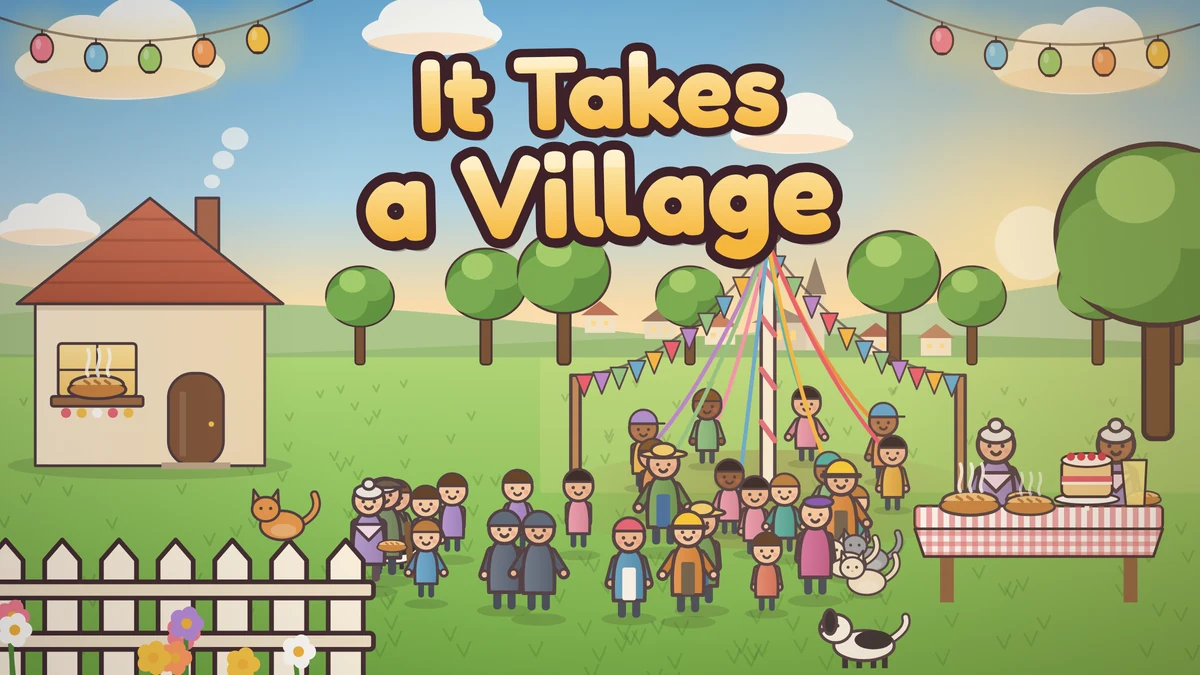
Each day shows one job, a bar of work to fill and the seconds left before dusk. Your villagers work on their own, and you can watch the job come together: stakes, scaffold, walls and then a roof on building days, baskets filling on harvest days, piles shrinking on tidy days and bunting going up for festivals. The sky is the clock. It warms, darkens and the lanterns light as dusk gets close. Fill the bar in time to finish the job and earn thanks. If dusk comes first, you lose one of your three hearts and move on.
Grannies bake pies on their own timer and serve them straight away: each pie refreshes tired villagers and adds five seconds of 40% extra work. One granny bakes every 6 seconds, two every 3 seconds. Tired villagers visibly slump and work at barely a third of full speed, so energy matters on long days.
Village moments
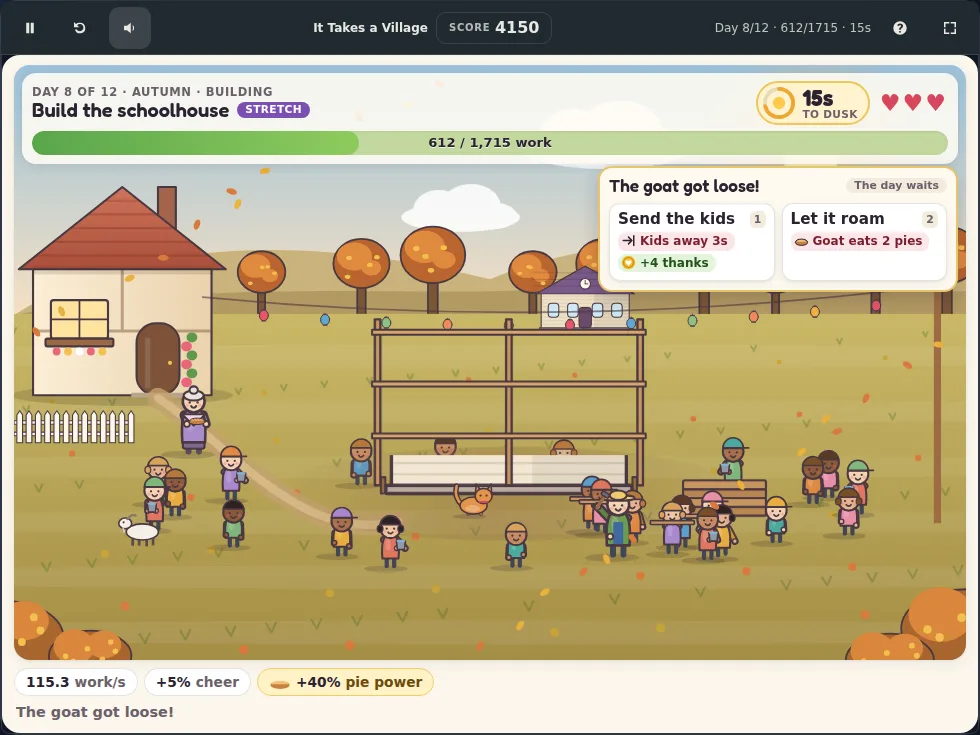
Once or twice a day a small card appears in the corner with two answers, and the day waits while it is open: the clock, the work and the tiredness all hold still until you choose, so there is time to read both answers. Each answer lists what it does in one or two short lines with an icon, green for a gain and rose for a cost. Tap an answer or press 1 or 2. Every moment has a free answer. There are fourteen moments, matched to the season and to who lives in your village.
Each answer is a real trade. When the goat gets loose you can send the children after it, losing their work for three seconds but earning 4 thanks, or let it roam and eat your next two pies. In a rain shower you can shelter, halving work for three seconds while everyone rests, or push on and tire three times as fast for eight seconds. A passing peddler sells a tool that adds 25% work for the rest of the day for 6 thanks. The best answer depends on the moment: a tool is worth it early in a tight day and wasted when the job is nearly done.
Steady or stretch: choosing tomorrow's job
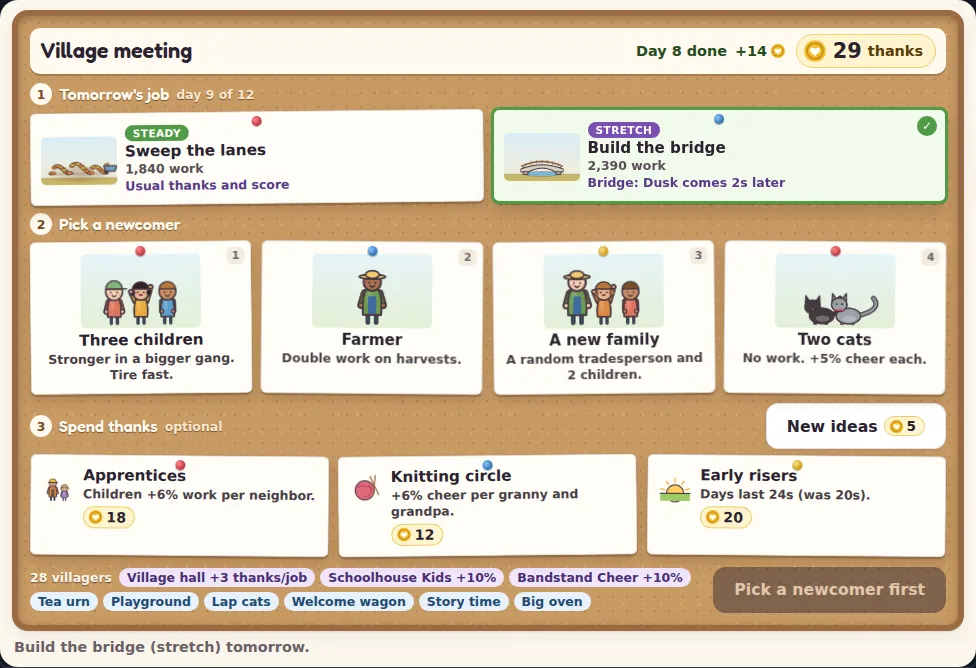
Every village meeting starts with a choice between two jobs for the next day. The steady job asks for the normal amount of work and pays the usual thanks. The stretch job asks for 30% more work, scores half again as much and either raises a building or pays 6 extra thanks. Missing a stretch job costs a heart like any other day, so take it when your village usually finishes with seconds to spare.
Buildings stay in the village for the rest of the year and show up in the background, with a small bonus each: the well makes everyone tire 15% slower, the bakery bakes pies 20% sooner, the barn gives neighbors and teenagers 1 more work a second, the schoolhouse adds 10% to children, the bandstand adds 10% cheer, the village hall adds 3 thanks to every finished job, the bridge holds dusk off for 2 more seconds and the potting shed adds 20% to harvests. The earlier you build, the more days the bonus helps.
What each villager does
Children do 1 work a second on their own, plus 5% for every other member of their gang. Three children are barely useful; twenty children are a force of nature. A sheepdog does no work but counts as three children for the gang bonus. Children also tire fastest.
Neighbors each have a trade: farmer, builder, tidier or decorator. They do 3 work a second, double on jobs that match their trade, and they tire slowly. Each time a job of their trade is finished, every neighbor of that trade gains a little permanent experience, so choosing jobs that match your neighbors pays twice. Teenagers do 4 work a second but run out of puff quickly.
Grannies and grandpas only manage 0.6 work a second. Grannies bake pies, more often the more grannies you have. Each grandpa tells stories that slow down how quickly children tire. Cats do no work at all, but each one adds 5% cheer, which multiplies everyone.
Village meetings and improvements
After choosing the job you must welcome exactly one newcomer from the cards on offer, then you can spend thanks on improvements. The notice board shows your thanks, everything already built and every improvement you own.
Thanks are limited. A finished job earns 6, plus up to 5 more for finishing early, plus a little extra later in the year. Some moments add or cost a few thanks too. Improvements cost 10 to 20, and New ideas swaps the three on offer for 5 thanks. You will not afford everything, so improvements that suit your crowd are worth far more than a little of everything.
Three villages that can finish the year
The big gang: take every group of children and any sheepdog, add a grandpa or two, and buy Playground, Story time and Lap cats. The gang bonus grows with every child, so this village starts slowly and finishes strong. Keep a granny or two for pies, because a tired gang slows down badly.
The specialists: welcome neighbors and teenagers, buy Tool shed and Know-how, and pick the job that matches the most neighbors each day. Specialists gain experience every time they finish their kind of job, and a barn adds to every one of them.
Cats and pies: collect two or more grannies, a gang of children and a few cats, then buy Big oven, Busy hands, Cat flap and Knitting circle. A bakery makes the pies come even faster. Cheer and pie power multiply the whole crowd.
In our simulated years, each of these builds finished roughly four years in five when it also chose jobs well and answered moments well. The same drafting that always took the free answer finished about half its years.
Scores, stars and replaying a year
Each finished day scores 100 points times the day number, or 150 times on a stretch day, plus 20 for every whole second left before dusk. Finishing the year adds 300 for each heart left. A finished year earns one star, 12,000 points earn two and 14,200 earn three, which usually takes a few stretch jobs.
Every year has a number shown on the title and results screens. Retry this year starts the same number again with the same first offers, and the game remembers your best for each of the last twelve numbers.
Controls, saving and accessibility
Days play out on their own apart from the moments. Tap or click a moment answer, or press 1 or 2 (the left and right arrow keys work too). At a meeting, tap or click the job, newcomer and improvement cards; on a keyboard, number keys 1 to 4 choose a newcomer, and Tab with Enter or Space works on every button. The toolbar offers pause, help, restart, optional sound and fullscreen. Pausing stops everything.
Your best score and stars, how many years you played and finished, and your best for recent year numbers are saved on this device, and a best score from the first version of the game carries over. A year in progress is not saved. Reduced motion stops the crowd animation, particles and weather movement, but days still run on a 20-second timer. We checked the game with automated desktop and phone browser runs and simulated thousands of years to tune the difficulty. These are not tests on physical devices or with real players.
Grow another village
Every year has its own number, and the same number deals the same first offers, so you can retry a year that got away. Try a different build next time, and see whether you can earn all three stars. If you enjoy planning a small team, Oven and Apron is a turn-based baking puzzle with a similar feel.
- Play It Takes a Village
- Oven and Apron: plan a small bakery schedule
- Full House Bakery guide: recipes, scoring and which regulars to seat
More guides and roundups
Want a warm kitchen game? Pick from seven free CozyWorld bakery games, from oven timing to card baking and order packing, then try these cozy baking favorites.
Oven & Apron Guide: Plan Every Bakery DayA cookie needs one step, a layer cake needs five across three stations. Fitting a whole day of orders into a small kitchen is a calm puzzle you can think about for as long as you like.
Best Cozy Puzzle Games to Play in 2026Match mahjong tiles, solve sudoku and killer sudoku, stitch a nonogram, find hidden words, fit a jigsaw, rake leaf piles, sort shells, merge fruit or crack firefly codes. Choose a puzzle by the decisions it asks you to make.
Best Cozy Tower Defense Games to Play in 2026Want waves, helper placement, and strategy without a harsh mood? Start with Beehive Bloom Defense, then try these tower defense favorites.